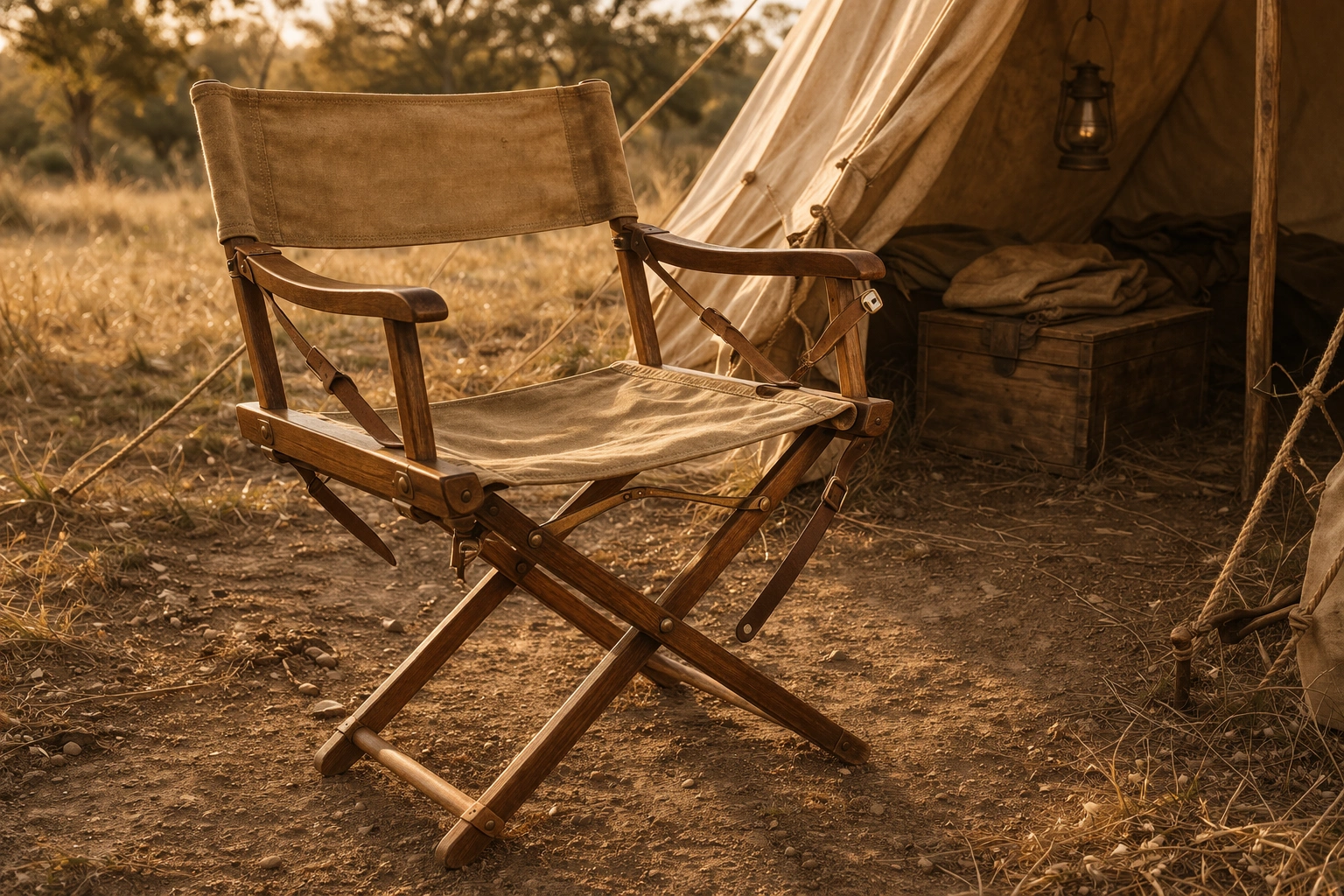
The true precursor to the modern camping chair emerged from military necessity during the mid-19th century. Wars in Europe, colonial campaigns in Africa and Asia, and the American Civil War created demand for portable seating that officers could carry into the field. The campaign chair — a folding wooden X-frame with a canvas sling seat and back — became standard issue for officers on both sides of the Atlantic.
The engineering was elegant in its simplicity: two wooden frames crossed in an X shape, connected by a pivot bolt. When opened, the X created a stable four-point base. When folded, the frames collapsed flat against each other. The canvas seat and back hung between the frames, creating a sling that conformed to the sitter's body. This basic mechanism — crossed frames + suspended fabric — remains the foundation of most camping chairs produced today.
By the late 1800s, civilian manufacturers recognized the commercial potential. Companies like Gold Medal (founded 1892 in the UK) began mass-producing folding chairs for outdoor leisure, not just military use. The African safari era popularized the "safari chair" — a sturdier variant with armrests and a higher backrest, designed for hours of game viewing. This design directly evolved into what we now call director's chairs.
These early models weighed 10–15 pounds — heavy by today's standards but revolutionary for an era when outdoor seating meant carrying a wooden bench. They proved that comfort and portability could coexist, a principle that would drive every innovation to follow.